Feb 2026 to present
Postdoctoral Research Fellow
National University of Singapore
Adversarial robustness of distributed quantum machine learning, and quantum generative modelling.

Postdoctoral Research Fellow National University of Singapore
I work on machine learning systems pulled apart across many parties, and on what it takes to keep them accurate, private and trustworthy once they are. Currently: distributed quantum machine learning.
Counts from Google Scholar, including 37 papers in IEEE journals and magazines and 12 in Transactions.
One question runs through all of it: when a learning system is split across hospitals, vehicles, devices or quantum processors that cannot fully trust each other, what breaks, and how do you fix it?
My current work at NUS studies the adversarial robustness of quantum models trained across separate parties, and quantum generative modelling. At Melbourne I built APS-pQFL, a personalised quantum federated learning method that uses soft masking and circuit-level sensitivity analysis to keep accuracy up on highly skewed non-IID medical data, the regime where a single shared model degrades worst.
Split learning, federated learning and incremental learning for clinical data that is not allowed to leave the institution holding it, with the client selection, feature selection and lightweight-client problems that come with Internet of Medical Things deployments.
Ledger-backed protocols for parties that have to cooperate without trusting one another: e-prescription management, medical record sharing, anomaly detection in connected-vehicle platoons, and traceability in physical supply chains.
Taxonomies and evaluations of diffusion and language models across healthcare, security and consumer systems, together with machine unlearning as a way to take training data back out of a deployed model.
Wi-Fi channel state information for human activity recognition, fall detection and hand hygiene monitoring, plus diffusion-guided augmentation for vision-based accident detection in vehicular networks.
Where an area is moving too fast to have a shape yet, I build one: taxonomies and architectural frameworks for quantum AI in mission-critical systems, for generative AI in the quantum era, and for machine unlearning. Each one sets out the open problems I then go after.
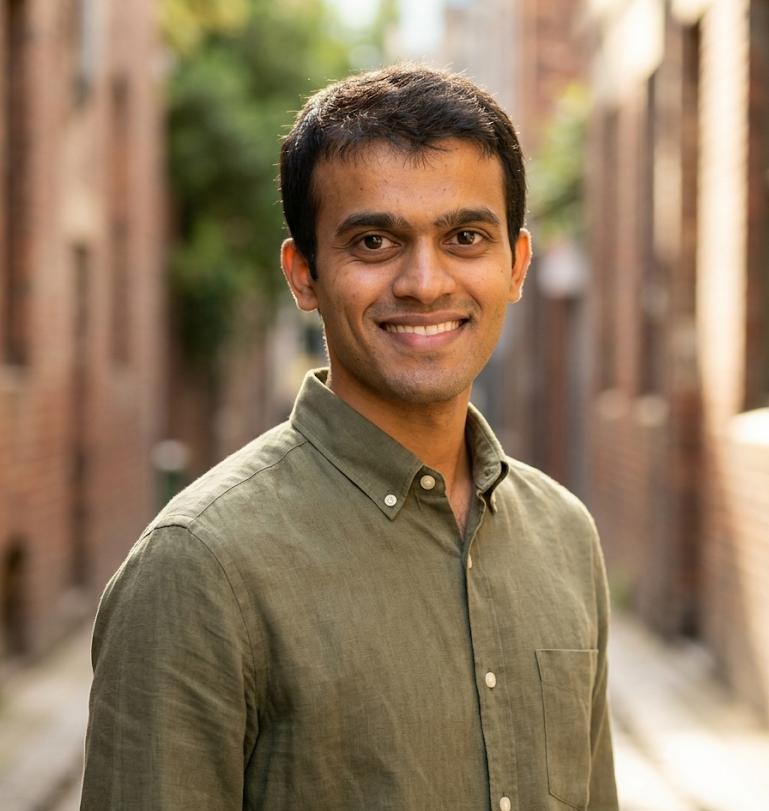
I am a postdoctoral research fellow at the National University of Singapore, where I work on the adversarial robustness of distributed quantum machine learning and on quantum generative modelling. I completed my PhD at BITS Pilani in December 2025 under Prof. Vinay Chamola, on the confluence of blockchain and AI technologies for next-generation healthcare solutions, and spent the closing months of 2025 at the University of Melbourne as a visiting researcher with Prof. Rajkumar Buyya, working on distributed quantum machine learning. Before the PhD I read Computer Science and Economics at BITS Pilani, finishing with a CGPA of 9.03 out of 10.
The through-line across my work is distribution and trust. I have built split learning and federated learning frameworks for Internet of Medical Things deployments, blockchain-backed protocols for prescription management and connected-vehicle anomaly detection, and most recently APS-pQFL, a personalised quantum federated learning method for heterogeneous healthcare networks. The recurring technical problem is heterogeneity: clients that hold very different data, run on very different hardware, and cannot be trusted to behave. APS-pQFL answers it on the quantum side with soft masking and circuit-level sensitivity analysis, personalising each client's circuit instead of forcing a single shared model onto all of them. On the classical side I have built a client selection method that chooses which hospitals to train with rather than averaging over everyone, a feature selection algorithm for incremental learning on IoMT streams, and CSITime, a privacy-preserving Wi-Fi sensing model for human activity recognition that needs no cameras or wearables. The work appears in IEEE Transactions on Consumer Electronics, IEEE Transactions on Intelligent Transportation Systems, IEEE Internet of Things Journal, ACM Transactions on Internet Technology, Future Generation Computer Systems and Neural Networks, and has been cited roughly 2,800 times.
National University of Singapore
Adversarial robustness of distributed quantum machine learning, and quantum generative modelling.
University of Melbourne
Distributed quantum machine learning with Prof. Rajkumar Buyya. Developed APS-pQFL for privacy-preserving medical diagnostics across IoMT-enabled institutions, co-authored a Morgan Kaufmann book chapter on quantum federated learning, and contributed to work on quantum-integrated high-performance computing.
Edinburgh Napier University, with Prof. Amir Hussain
Led an international team working on generative models for immersive and metaverse systems: which architectures hold up under the latency and compute budgets of real deployments, and how they fail. Two journal papers.
National University of Singapore, with Prof. Biplab Sikdar
Led an international team on secure and scalable healthcare solutions, and on consumer electronics technologies for the metaverse. Three papers in IEEE journals and magazines.
University of Texas at San Antonio, with Prof. Heena Rathore
Implemented TangleCV, a distributed ledger framework for connected vehicles, from scratch in Python and evaluated it on the SwRI dataset under parasite chain attacks and sensor faults.
Couture.AI, Bangalore
Feature extraction and matching over a large apparel image database using SIFT, SURF, BRIEF, histogram and LBP methods in OpenCV, with a Flask API for a dress-object recognition model.
Nineteen papers that represent the range of the work, first-authored technical contributions first. Filter by area, or see the complete list on Google Scholar.
IEEE Internet of Things Journal
Impact factor 8.9
Under revision
IEEE Transactions on Consumer Electronics, vol. 70, no. 3, pp. 5887 to 5894. Outstanding Research Article Award, EEE Department, BITS Pilani
Impact factor 9.9
IEEE Transactions on Consumer Electronics
Impact factor 9.9
IEEE Internet of Things Journal, vol. 11, no. 4, pp. 5568 to 5577
Impact factor 8.9
IEEE Transactions on Vehicular Technology, vol. 74, no. 2, pp. 2241 to 2250
Impact factor 7.5
ACM Transactions on Internet Technology
Impact factor 5.1
IEEE Transactions on Machine Learning in Communications and Networking, vol. 2, pp. 370 to 383
Impact factor 4.9
IEEE Transactions on Intelligent Transportation Systems, vol. 24, no. 7, pp. 7092 to 7107
Impact factor 9.1
Neural Networks, vol. 146, pp. 11 to 21
Impact factor 7.2
Future Generation Computer Systems, vol. 184, art. 108602
Impact factor 6.1
Future Generation Computer Systems, art. 108714
Impact factor 6.1
Software: Practice and Experience
Impact factor 3.5
Book chapter in Federated Learning: Foundations and Applications, Morgan Kaufmann, pp. 325 to 343
IEEE Internet of Things Journal, vol. 10, no. 7, pp. 5873 to 5897
Impact factor 8.9
Cognitive Computation, vol. 16, no. 2, pp. 482 to 506
Impact factor 7.4
IEEE Internet of Things Journal, vol. 13, no. 10, pp. 20190 to 20214
Impact factor 8.9
IEEE Access, vol. 12, pp. 31078 to 31106
Impact factor 3.6
IEEE Access, vol. 12, pp. 53497 to 53516
Impact factor 3.6
Cognitive Computation, vol. 16, no. 6, pp. 3286 to 3315
Impact factor 7.4
No selected papers in that area yet. Try another filter.
University of Melbourne
Distributed and quantum machine learning, quantum-integrated high-performance computing.
National University of Singapore
Secure and scalable healthcare systems, consumer electronics for the metaverse.
Edinburgh Napier University
Generative AI, cognitive computation, machine unlearning.
Texas State University
Distributed ledgers and anomaly detection for connected vehicles.
Email is the quickest way to reach me. I am always glad to hear about collaborations in distributed machine learning, trustworthy AI, quantum computing or health informatics.